Every condition has its own rules when it comes to transportation. That is why, at SP Transfer, we have developed a model of mobility for patient associations supporting people with different conditions, where the absolute priority is not speed, but the patient's physical integrity and comfort.
Have you ever wondered how much peace of mind your team could gain if you had transportation services for mental health associations or mobility for patient associations supporting people with acquired brain injury managed by professionals who understand the calm and safety protocols required? These and other specialized transportation services are what we offer at SP Transfer for patient associations.
Every time a patient gets into one of our vehicles, a protocol developed over years of active listening to healthcare-sector organizations is put into action. A short journey for a check-up is not the same as a long-distance trip for specialized treatment. Understanding that difference is what allows us to provide a genuine, operational response. If your association supports people who are highly sensitive to movement, our approach is designed for you.
Mobility adapted
to the needs of each condition
If your users live with conditions that affect their autonomy, you need adapted transportation for ALS and neuromuscular disease patient associations that guarantees meticulous safety. It is not just about ramps, but about understanding the fragility of muscle tone and the need for exceptionally smooth driving.
We know that specialization is the only way to provide genuine specialized mobility for rare disease and low-prevalence disease associations, where medical equipment is often bulky and the patient requires constant attention. Likewise, we design transportation for oncology patient associations that prioritize clean, quiet environments, away from the stress of conventional transportation.
What do you expect from a driver transporting someone with severe reduced mobility? The answer should always be: training and patience. At SP Transfer, the human factor supports the entire technological structure, ensuring that the vehicle becomes, for a while, a safe and comfortable place.

Transportation that respects
the patient's pace and vulnerability
Rushing is a chronic patient's worst enemy. That is why we use low-vibration driving for associations supporting people with chronic pain, where every turn and every brake is performed with exceptional smoothness to avoid pain flare-ups or physical discomfort. We know that a poorly handled bump can ruin the entire day for someone with central sensitivity.
We also understand that boarding time is sacred. We do not pressure or rush. Our drivers are trained to provide boarding assistance for users from Parkinson's associations, respecting each person's motor blocks and response times. User dignity begins the moment they see us arrive at their front door.

Ergonomics and thermal comfort:
Key factors in healthcare transportation
Comfort is not a luxury; in many cases, it is a clinical necessity. That is why we have climate-controlled vehicles for patient associations supporting people with sensitivities, where temperature is constantly controlled to help prevent dehydration or cold-related episodes. A thermally stable environment reduces the passenger's metabolic stress and makes the journey much more comfortable.
When combined with ergonomic seats and space configurations that allow passengers to stretch their legs or change position, the result is a service that supports health while on the move. It is not just transportation; it is continuous care on wheels.

Contact us and let's design a transportation plan together that meets the needs of your association.
Request your quoteSpecialized mobility
for associations supporting people with serious conditions
When dealing with highly complex conditions, logistics must reach the same level as hospital care. The mobility solutions for patient associations we develop at SP Transfer are designed to be a strategic partner for boards and management teams. We know that your resources are limited and that the responsibility of transporting your members is enormous. Delegating that work to us means choosing technical excellence.

Adapted transportation
for ALS and neuromuscular disease patient associations
In the case of ALS, time and comfort are critical. Adapted transportation for ALS patient associations requires vehicles with fast yet ultra-secure anchoring systems, capable of accommodating large powered wheelchairs without compromising space for the accompanying person. We also provide transportation with support for medical equipment, ensuring that ventilators, suction devices and auxiliary batteries always travel securely and remain accessible.
Safe transportation
for oncology and chronic disease patient associations
For oncology patients, the environment should be as close as possible to a safe bubble. To achieve this, we apply hospital hygiene protocols for transportation services for associations, with deep disinfection after every service to protect users' immune systems. This transportation for oncology patient associations takes place in vehicles that guarantee maximum privacy and restorative quiet, which is essential after exhausting treatment sessions.
Specialized mobility
for rare disease associations
Low-prevalence diseases often present unique clinical profiles that do not fit standard transportation manuals. This is where our mobility services stand out. We adapt to the extraordinary because we understand that what others see as a complication is part of our daily operational specialization.
If your organization faces mobility challenges that no one else seems able to solve, let's talk. Logistics creativity, supported by a modern fleet, allows us to find solutions where others only see insurmountable barriers.

High-sensitivity logistics
for the D'genes community and low-prevalence conditions
We maintain a firm commitment to specialized mobility for rare disease associations, working closely with organizations that understand the day-to-day reality of these families. We understand that transportation is often the moment when the patient leaves their controlled environment, and our mission is to ensure they do not notice any difference in terms of care and attention.

Specialized equipment
for users with severe reduced mobility
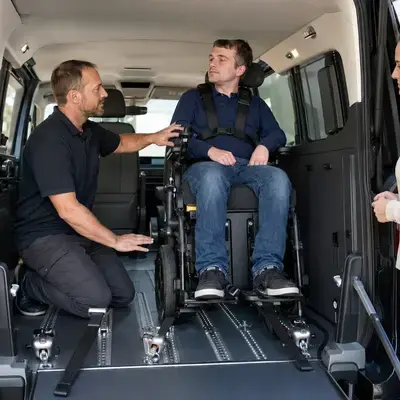
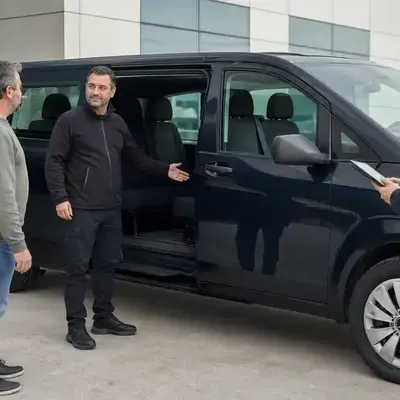
We do not cut corners when it comes to technical equipment. Our high-capacity ramps and air-suspension systems are essential for those who require complete stability. If the patient cannot be transferred to the vehicle seat, our certified anchoring systems ensure that their wheelchair remains the safest place in the passenger compartment throughout the journey.

Trust the team that understands that safety is also emotional.
Request your quoteSpecialists in transportation
for mental health and acquired brain injury associations
The transportation services for mental health associations require specific training in behavioral management and creating trusting environments. On the other hand, mobility for patient associations supporting people with acquired brain injury requires a structure that avoids overstimulation and helps users recognize their surroundings.

Low-stimulation environments
for associations supporting people with acquired brain injury
For mobility for patient associations supporting people with acquired brain injury or autism spectrum disorders, noise and light can trigger episodes of distress. That is why we offer vehicles with highly protective tinted windows and disconnectable sound systems to create a calm cabin. The goal is for the journey to be a smooth transition to the destination, without unnecessary disruption.


Support and calming protocols
on mental health routes
Our drivers are trained in transportation services for mental health associations, always maintaining an assertive and calm attitude. Support does not end when the door closes; we remain present to ensure that users feel understood and respected in their own pace and silences.
Technical commitment
to the well-being of your members
At SP Transfer, specialized mobility for patient associations supporting people with serious conditions is more than a business line; it is our way of contributing to the strength of the patient-association network. We know that behind every booking there is a family that trusts us and an association that puts its reputation in our hands.
We understand that excellence in care cannot have weak points and that comfort must be absolute. That is why we design tailor-made solutions aligned with the most demanding international hospitality standards, providing medical concierge transportation that combines operational rigor with highly human-centered support.
We continuously invest in climate-controlled vehicles and in training a team that understands that, in this sector, technique without empathy is of little use. Whether for a one-off service or to establish a long-term collaboration, count on us as your trusted logistics extension. Together, we make the journey much easier for everyone.
Mobility services adapted to every need of your Association
Frequently asked questions
about transportation adapted to specific conditions
1. What specific training does your staff have for specialized mobility for associations supporting people with serious conditions?
We do not assign just any driver. Our team receives training in patient mobility, first aid and applied basic psychology. In specialized mobility for associations supporting people with serious conditions, the human factor is just as critical as the vehicle; the driver knows that they are transporting people whose vulnerability requires absolute respect for their pace and needs.
2. How do you guarantee safe adapted transportation for ALS patient associations?
Adapted transportation for ALS patient associations is among the most demanding services. We use vehicles with four-point anchoring systems for heavy powered wheelchairs and low-angle ramps to avoid abrupt inclines. We also always leave free space around the wheelchair so that the accompanying person can assist the patient, for example with secretion management or ventilator adjustments, during the journey.
3. What hygiene measures are applied during transportation for oncology patient associations?
We follow strict hospital hygiene protocols, including disinfection with clinical-spectrum virucidal products after every service and continuous air renewal. During transportation for oncology patient associations, protecting the user's immune system is our top priority.
4. Do you offer solutions for specialized mobility for patient associations requiring complex equipment?
Of course. Specialized mobility for rare disease associations often involves transporting monitors, oxygen cylinders or spare batteries. That is why we provide transportation with medical-equipment support, with secure storage areas so that all vital equipment remains stable and protected from vibration.
5. How do you manage transportation services for mental health associations?
The key is environment management. In transportation services for mental health associations, our drivers apply assertive communication and low-stimulation protocols. We avoid harsh noises, loud music and unnecessary waiting times that could trigger anxiety or agitation in the user.
6. What protocols do you follow for mobility for patient associations supporting people with acquired brain injury?
In mobility for patient associations supporting people with acquired brain injury, order and calm are fundamental. We avoid routes with excessive traffic or abrupt changes of direction. The goal is for the patient to recognize the environment as safe and predictable, reducing the disorientation that travel outside their comfort zone can sometimes cause.
7. Is low-vibration driving for associations supporting people with chronic pain really possible?
It is both real and necessary. Low-vibration driving for associations supporting people with chronic pain consists of an extremely smooth defensive-driving technique: progressive acceleration, anticipatory braking and cornering that minimizes lateral force. If the patient feels every bump like a sharp pain, the driver is not doing the job properly. We do it properly.
8. Why is it essential to have climate-controlled vehicles for sensitive patients?
Because many conditions affect the body's thermoregulation. Having climate-controlled vehicles for sensitive patient associations allows us to maintain a constant temperature between 21 and 23 degrees, helping prevent heat-related fainting or cold-induced muscle stiffness. Thermal comfort is not an extra; it is a healthcare protection measure.
9. How does boarding assistance work for users from Parkinson's associations?
Boarding assistance for users with Parkinson's requires the driver to know how to wait for the patient to overcome an episode of "freezing" without rushing them. We assist during the step up, help maintain balance and do not close the door until the person is completely settled and comfortable.
10. How can organizations hire these mobility solutions for patient associations?
We assess the profile of conditions you commonly support and propose mobility solutions for patient associations that fit your schedules and budgets. We do not want to be an external supplier; we want to be the logistics arm your association needs so that no one misses their treatment because of a lack of suitable transportation.

Contact us and let's design a transportation plan together that meets the needs of your association.
Request your quoteOther related services